



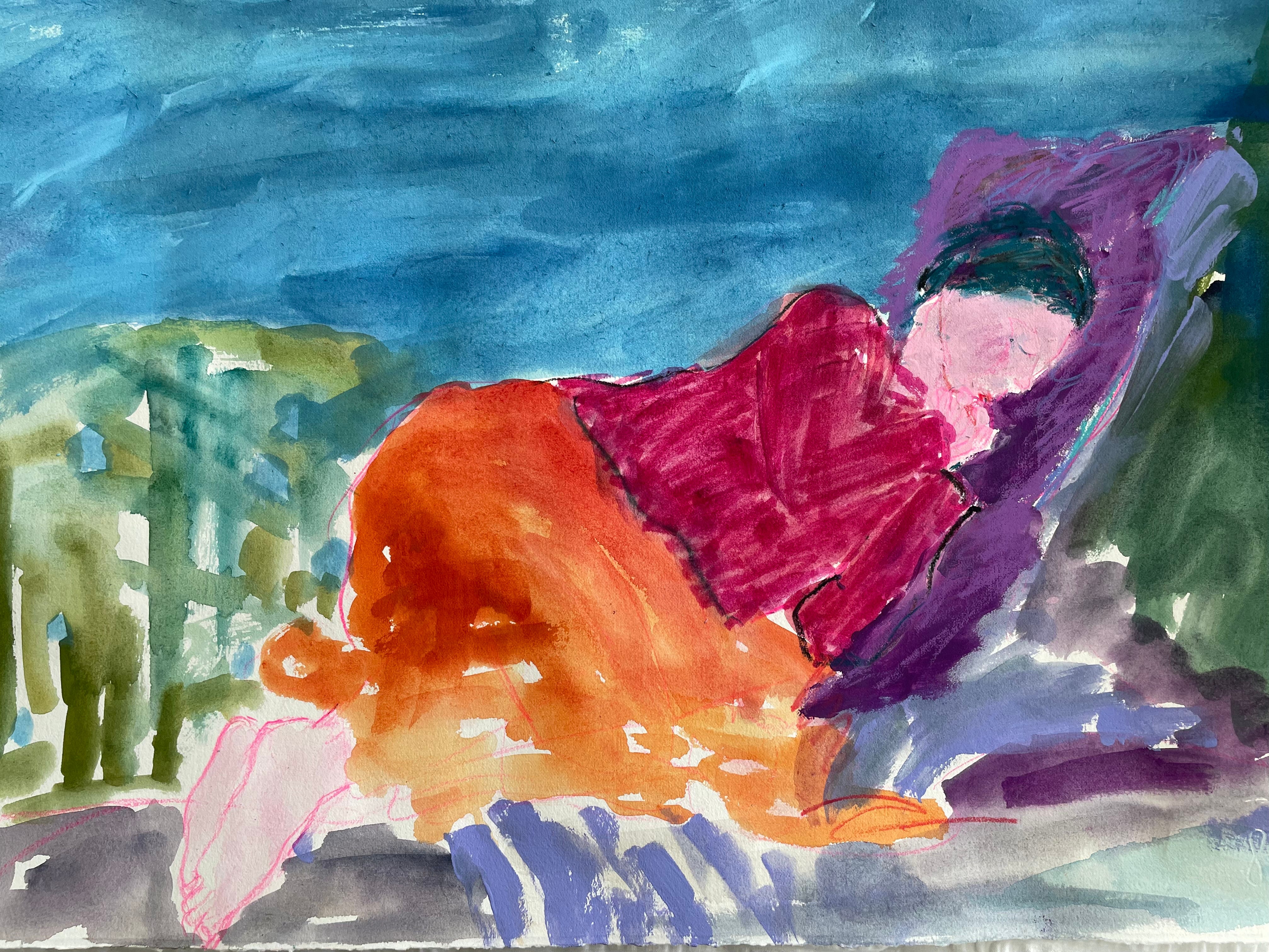
End of Week Twenty-Four by Pregnancy’s Calendar
In these last, amber-lit days of October, the aspen and cottonwood trees still hold their yellow-gold leaves. Climbing into Santa Fe’s foothills, I roll down the windows, breathe in the gin smell of juniper and scents less easy to identify in this dry, high-altitude air. The last time I was here, five months ago, feathery yellow poppies and purple lupine flanked the steep road leading up to the tiny house. Now it’s all fiddle-shaped scorpion weed and brown-edged yucca and cacti.
I pull into the driveway, take in the house with its weather-beaten door. Here, five months ago, I first heard the ‘good news’ of my pregnancy. Had it held on, today would mark the end of the twenty-fourth week, and I’d be nearing the end of the second trimester. The so-called “honeymoon” trimester in which most women thrive, as I did when, six years ago I carried my daughter, suffused with energy and hope.
End of Week Twelve
“Let’s have a look at your beautiful baby,” Dr. Phillips says on the morning of the ultrasound.
Because of technology’s centrality in IVF, the ultrasounds are almost routine. I first glimpsed this being in the sixth week. “The fish stage,” Dr. Phillips called it when a blurred question mark appeared on the screen, the head being what predominated along with a faint white blip—the beating heart.
At the eight-week ultrasound, I heard the heartbeat, sublime proof of thriving life. “And look at how your baby’s moving,” Dr. Phillips said as the almond-sized being somersaulted on the screen. “A very good sign of brain activity.”
Everything seemed to be going so well; now, at this twelfth week ultrasound, I anxiously anticipate how much more human this being will look. Dr. Phillips slides the ultrasound wand inside me, and “my beautiful baby” appears on the screen, the eyes in place, ears and hands present, fingers folded into clearly recognizable fists. The fishlike tail is gone, in its place two tiny feet tucked up against a body dwarfed by the head.
So entranced am I by this image—by the fact that we’ve made it this far—I don’t realize how silent the room’s become.
Dr. Phillips’s hand grips my own. “Jacqueline,” she says. “There’s a problem.”
“I don’t understand.”
“I don’t hear the baby’s heart.”
“I don’t understand,” I say again.
“The heartbeat, I can’t find it,” she says, entwining her fingers with my own. “I’m so, so sorry,” she says. “You don’t deserve this, not after everything you’ve been through.” She hurries on, breathless. “We did everything right.”
Dr. Phillips’s words flow in and out of me as she explains that the baby, the placenta, and the entire infrastructure of the pregnancy will have to be removed. “You’ll be under a complete anesthetic, and I’ll do the surgery,” she says.
“Surgery?” I say, my mouth dry, as I wrap my arms around myself.
“There’s a small risk of infection, scarring, but I’m very careful,” she says, her blue eyes bluer now given her own tears. “We can do this as early as tomorrow morning—”
A few minutes later, she sends me down the hall for further ultrasounds by a specialist—“I know what I see, but we need a confirmation. And Dr McIntyre might be able to discern more.”
Accompanied by Kathleen, my favorite nurse, I walk down what seems an endless hospital hallway, wishing I could just keep walking, until I awake from what I wish was a terrible dream.
We reach the end of the hall. “If you need anything,” Kathleen says, mascara smearing her tear-stained cheeks, “anything at all, call me.”
“Thank you,” I say.
An unfamiliar nurse leads me into yet another examination room where I stand shivering until she reminds me to get undressed from the waist down. In this room, over the course of the next hour, a kind, elderly doctor looks at the baby on an ultrasound screen; this one has a three-dimensional feature that brings the now dormant world in which my long-awaited child began into gruesomely cinematic reality.
“There’s a cystic structure on the umbilical cord,” Dr. McIntyre tells me. “I’ve never seen this before, but it’s the only abnormality I can find. We won’t know until after the results of the surgery—after the fetal analysis—but my belief is that your pregnancy terminated sometime during the tenth week. Likely this cystic structure inhibited blood flow. At this stage,” he says, laying a hand on my forearm, “there’s very little sense of consciousness.”
Two hours later, I go from the obstetrics and gynecology to admitting where, with Bill beside me, I sit on an aluminum chair and register for the next morning’s surgery. Afterwards, in the hospital parking lot, my husband wraps me up in a tight embrace. He doesn’t cry, just stands there, holding me, the images of this morning burned into my mind, onto the backs of my eyelids.
When I was pregnant with Sophie—even before the tests confirmed it—he knew that she was present and that everything would be okay, and he told me this many, many times. Sophie was conceived naturally unlike this child whose beginnings came into being in a petri dish. For Bill, connecting to this pregnancy has been far more difficult.
But this longed-for being’s death, this is undeniably real.
For the next two weeks, I’ll have to stay out of the water because of the risk of infection, so on this night before the surgery, I stay in the chlorinated blue for hours, plunging underwater and transforming the world into a continuum of blurred forms.
“Catch me, Mama!” Sophie calls again and again, as she dives off the edge of the pool, crashing into my arms. “Catch me!”
I watch her plunge fearlessly into the water and wonder how she will make sense of this loss. What can such a small child know of death? What should she know?
In the morning, I arrive at the hospital well before seven a.m., but the surgery doesn’t happen until one o’clock because Dr. Phillips’s previous surgery, a severe case of endometriosis, proves far more complicated.
Afterwards, I wake around four, according to the clock on the wall. Flat on my back and still hooked up to the IV and bleeding onto the matting beneath me, I try repeatedly to stop someone in scrubs as they pass my partially open door. Astonishingly, despite all of the hookups in this room and the big screen TV, I can’t find a call button anywhere.
“It looks like it fell to the ground,” the nurse says when she finally enters close to five p.m., panic registering on her pale, freckled face.
“Well, it’s medicine 101 to have a call button, right?” I spit back. “I mean I’m lying here in bloody swabbing, and I have to pee, and I’m hooked up to this stupid IV so I can’t go anywhere, and no one’s around to even hear me.”
“I’m so, so sorry,” she says, immediately removing the IV so that I can stand up, and then she removes the soiled padding before pointing me in the direction of the bathroom.
Afterwards I glance down, appalled at the toilet now filled with soft tissue and dark bloody globs, and resume sobbing, muffling my cries with a washcloth.
“Are you okay?” the nurse says when I step out of the bathroom.
“Let me see,” I say, the coiled fury loosing itself at last. “Yesterday, I thought I was having a baby. The routine ultrasound confirmed that I wasn’t. Today, I had what I thought would be my child and everything else scraped out of me. No,” I say, nearing hysteria, “I would say I’m not ‘okay.’”
“I know,” she says, the corners of her pink lipstick-mouth quivering.
I stare at the white support hose Dr. Phillips insisted I wear to prevent blood clotting, as if a blood clot would dare to happen after everything else. “You understand?”
“I went through this, too, ten years ago. How far along were you?”
“Twelve weeks.”
“I was at twenty-two. I know how awful it is.”
I close my eyes, unable to imagine miscarrying halfway through a pregnancy, and simultaneously ashamed of my rudeness.
“Let me bring you some crackers and something to drink,” she says. “If I’m right, you haven’t eaten since last night.”
“Alright, thank you.”
Miscarriage, I now know, is more common than I thought. No wonder too many people here refer to this procedure as D&C as if it were shorthand for decaffeinated coffee or some administrative abbreviation and not the removal of what was becoming a human being.
“I’m sorry,” I tell the nurse when she returns. “I’m not usually such a bitch.”
She shrugs. “It’s okay. Plenty of people come out of anesthesia fighting mad. A woman last week tried to bite another nurse.” She sighs. “I should have come to check on you earlier. I assumed you were still out of it.”
“I wish I was,” I say, and laugh.
Weeks Thirteen thru Seventeen
In the weeks that follow, I’m often sleepless. Days, when I can, I walk for miles, my spirited terrier Josie accompanying me. Then I retrace the last month almost obsessively. If the specialist was right, the baby died in late July, some ten days before my birthday. Did the fever before the twelve-week ultrasound have anything to do with the fact that my body was trying to hold onto what was no longer living? And if I hadn’t been swallowing estrogen and injecting progesterone as per Dr. M’s long-distance orders, would the death have become apparent much, much sooner, so that I could have miscarried naturally?
I’ll never know.
The hormones I ingested and injected for three months, hormones I would have stopped taking at the end of the twelfth week, kept telling my body that a human being was growing inside me, when that was no longer true. For nearly two weeks after the death, I stayed on those hormones, injecting an inch of progesterone each morning and swallowing estrogen twice a day. Shouldn’t someone—Dr. M in Los Angeles, Dr. Phillips here in town—have monitored me more closely?
“The death was an absolute rarity,” the specialist, Dr. McIntyre. “I’ve never seen anything like it in his forty years of practice.”
But underlying all of this—what Dr. M called my “terrible bad luck”—was the fact that I’d been trying to fly in the face of biology by trying to have a child in my forties. Didn’t another mid-forties doctor friend tell me that I might do better to just face reality, specifically my biological peri-menopausal age?
IVF tries to deny that reality, convincing women like me, healthy, active women in our forties, with some financial resources, that we can have it all—or at least, another child.
“I’m sorry, Monkey, I just can’t help you with this,” my mother says in one of our late-night, long-distance calls.
On the day after the surgery, Dr. M, the doctor who implanted the embryos, leaves a message on my voicemail, his voice choking up—a little theatrically, I think—as he repeats the facts of the situation. I heard what happened. I know there was a problem with the umbilical cord. I know there will be genetic testing. I’m very sorry to learn all of this. All of us are. Please, when you are ready, call me.
“I’m not sure I ever want to talk to him again,” I tell Bill, who, as he reminded me many times during the last year, neither trusted nor liked Dr. M. He’s a salesman, not a doctor, Bill said. He wasn’t so far off. Dr. M always stressed the success rates, the state-of-the-art technology, his own competence, leaving out the many, many things that could and did go terribly wrong.
That said, what I don’t realize at the time is that I’m in denial. I find myself making a sort of deal with God, or at least a deal with time and history, as if that will bring the baby back. If I could turn back the clock to August 7 and go into Dr. Phillips’s office and hear her say, “Ah, just look at your beautiful baby…” If we could celebrate the thriving sound of that baby’s heartbeat, I’d give up…I’d promise…I’d change… If I could watch him somersault on the screen. If, If, If…
For a time, my denial is almost hopeful. Later it recalls Joan Didion’s determination to keep her husband’s shoes and clothes neatly arranged in his closet after his death. He will need them, she tells herself, once he comes back…
Yes, denial is both hopeful and painful, and I assume it plays a protective role in the psyche, for who can live with raw grief twenty-four hours a day?
Anger is something else, searing and red. And mine has become an out-of-control extension of the anger I’ve felt ever since the first IVF procedure failed six months before the “fantastic number” of early June. Back in December, I stifled my anger at Dr. M for making the decision to implant one embryo (and not two) without consulting me, thereby reducing my chance of becoming pregnant by twenty-five percent right from the beginning. Immediately after that first unsuccessful transfer, I became suspicious of the fact that reproductive technology had basically become big business involving big money. Before losing this pregnancy, what I kept telling myself was that IVF—Dr. M’s invasive intimacy, the hormones, the endless monitoring—would at last be relegated to The Past, and I could focus on the pregnancy and my coming child.
Now, as the medical bills come in, one by one, quickly totaling some three thousand dollars, I find myself reminded, on a whole new level, that this is hardly The Past.
Weeks Fifteen & Sixteen
On August twenty-seventh, some three weeks after the surgery, Sophie, Bill, and I bike over to the grade school for her first day of kindergarten. The school day begins at the ungodly hour of seven-forty-five, thereby eradicating our daily practice of reading picture books in bed for a good hour after waking at the more civilized hour of eight. It also means struggling to get our night owl daughter asleep by nine.
Eventually, with kindergarten’s regimen in place, or at least setting the tone for the day, mornings center on waking early (if we’re lucky), scrambling to get breakfast together, Sophie dressed, and her backpack and lunchbox together, and navigating the six blocks to school.
At 3:20 pm, Bill or I stand among the other parents, grandparents and the occasional babysitter, eagerly awaiting our child’s return as they exit in single file. “I’m hoping I’ll get used to it, this schedule I mean,” I tell my neighbor, Jessica, whose youngest is now in second grade.
“Good luck,” she laughs. “Matt is in eighth grade, and I still haven’t gotten used to it.”
Week Twenty-two
It’s late September before the lab results come back, and I return to the hospital to meet with Dr. Phillips. “This is the hard part,” she says.
“Just tell me,” I say, gripping the edges of the examination table.
“A boy,” Dr. Phillips says, handing me the lab results. “A genetically normal boy.”
I sit. Silent. Numb. This outcome confirms that the problem was with the umbilical cord. It confirms what Dr. M had only hinted at: somewhere in the donor’s genetic profile lurked this phenomenally rare possibility, one that my husband seems to share. My mouth has gone dry. A genetically normal boy. We would have called him ‘Daniel’. A son. A brother for Sophie.
She steps closer, and we hold each other. “I’m so very, very sorry.”
“I know you are,” I say, reminded of how she tried to comfort me just before the anesthetic took hold. “I’m grateful that you’re my doctor.”
“Thank you,” she says, and gradually lets me go. “What about Dr. M? Have you spoken to him since the surgery?”
“Last week,” I say, reminded of the hurried phone conversation, his GSD droning on in the background. “He told me that if the lab results showed that the baby was normal, he would recommend that I go through the procedure once more with the remaining three embryos. He said I owed it to the embryos and to myself to complete what we’d started.”
“That’s one way of looking at it.” Dr. Phillips says. “So, will you?”
“No,” I reply, owning this decision at last, the fact that I cannot undertake this journey again—not after all that’s happened. “I have my daughter to think about, my own well-being, which hasn’t exactly been great lately.”
“Yes, you do,” Dr. Phillips says, and embraces me once more. Unlike Dr. M, Dr. Phillips is married with children of her own. “I didn’t tell you this before,” she says, “but I, too, was living for your pregnancy’s success. What I see, so much of the time, is disappointment, loss.”
I’m reminded of an earlier visit when my appointment was delayed for ninety minutes; the reason, a woman who lay in a darkened room in Dr. Phillips’s office. I gave so little thought to her circumstances then, so caught up was I in my own journey.
“Sometimes, I ask myself why I’m doing this,” she says. “So much of the time, it doesn’t happen. Women come to me with severe endometriosis, and all too often the reasons for their inability to conceive remain mysterious. But there are those precious moments when a baby is born,” she says, light coming into her face, her voice, “when it happens—”
“The miracle,” I say.
“Yes,” she says, pulling me closer, “exactly that.”
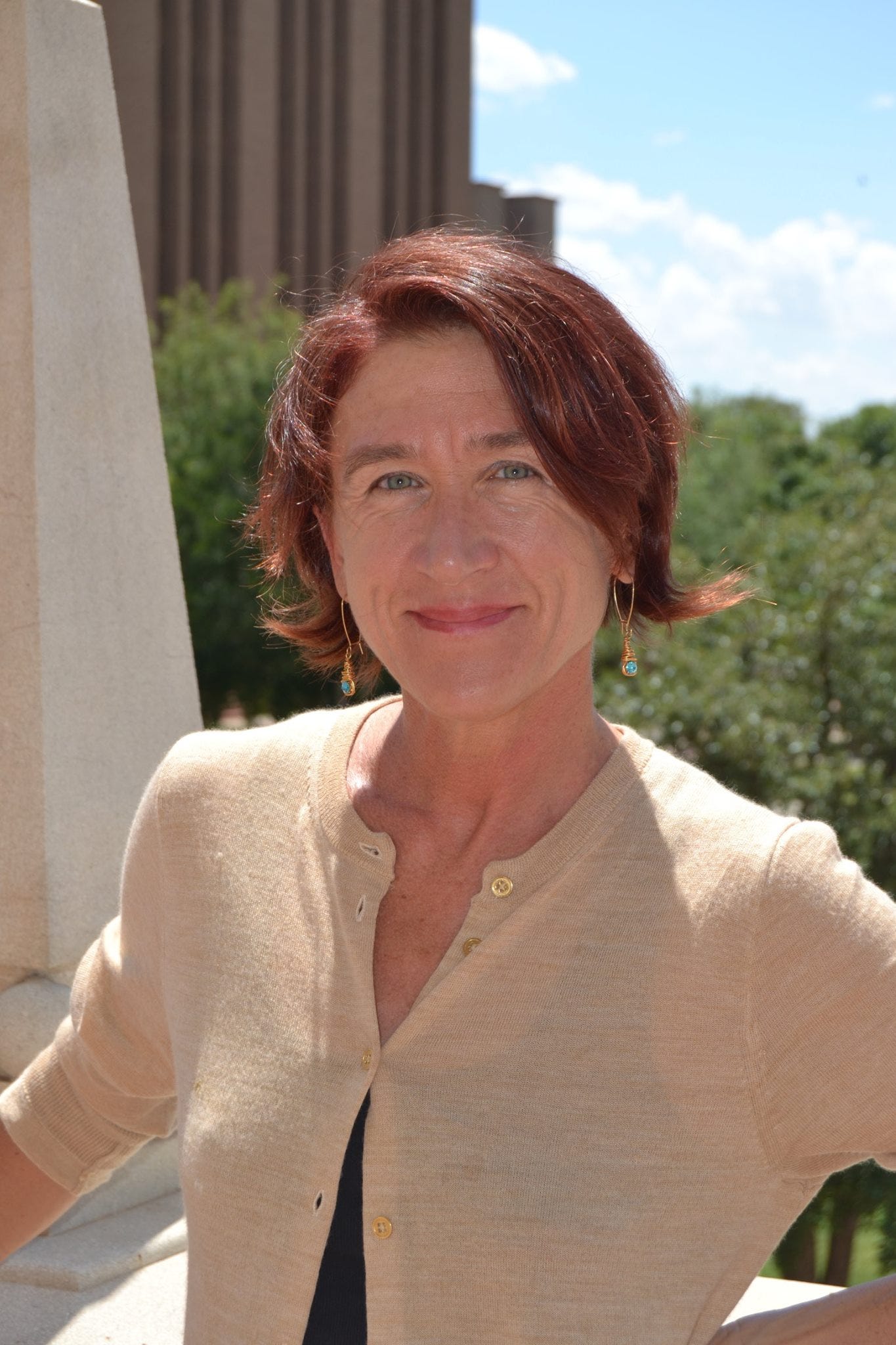
Jacqueline Kolosov’s collection of essays, Motherhood, and the Places Between, is forthcoming from Iron Oak Editions this October; talons, wings, her 4th poetry collection, is forthcoming later this fall from Saint Julian Press. She has published several books of fiction and coedited 3 anthologies of contemporary prose. Originally from Chicago, she now lives, teaches, writes, and rides her big-hearted thoroughbred on the Llano Estacado in West Texas. She serves on the Creative Writing Faculty at Texas Tech. Social media: @imaginejacqueline (instagram), Cassieoppiea Kolosov on Facebook
Artist Arlene Tribbia is an artist/poet who works across disciplines experimenting and exploring the boundaries and variations within poetry, drawing, painting, story and sculpture. Drawing is a poem. Every line is a verse. Every color or random mark is a phrase. These lines and gestures gathered create stanzas, stories, drawings and paintings. Stories of hers have been nominated for the Pushcart Prize and published widely as well as internationally. Her artwork has been exhibited in unique spaces from dance halls to skyscrapers as well as galleries, including Woman Made in Chicago and the Dunedin Fine Art Center in Florida where Robert Rauschenberg (hero, mentor-in-my-mind and influence) also has shown his work. http://www.arlenetribbia.com/
Your writing is powerful. I’m certain your words will bring community and healing to many women who have struggled to conceive. Peace.
I look forward to reading Motherhood when it comes out. I am with you on self promotion.. pimping my book I call it. I hate it. That said, I would love it if you would read my memoir - A Tree with My Name on It: Finding a Way Home. You can read all about it, including sample chapters and see links to where to buy it on my website - victresshitchcock.com. When I looked you up I saw a number of pictures of you with horses. One of the main themes of my book is how I found ways to heal by facing and embracing my fear through my relationship with my horse Rain. It was life changing for real...